

The pea (a.k.a. bean or legume) family, Fabaceae, is the third largest plant family and includes a plethora of vines, herbs, shrubs, and trees. It is sometimes called by its older name, Leguminosae, and includes around 20,000 species and 750 genera.
When we visited Pelican Island National Wildlife Refuge (PINWR) on 10/8/23, we saw lots of hairypod cowpea (Vigna luteola) growing along the mosquito control impoundment dikes. This fast-growing vine clambers atop mangroves, other vegetation, and itself.

Its leaflets are held in 3’s …

Flowering often is profuse …
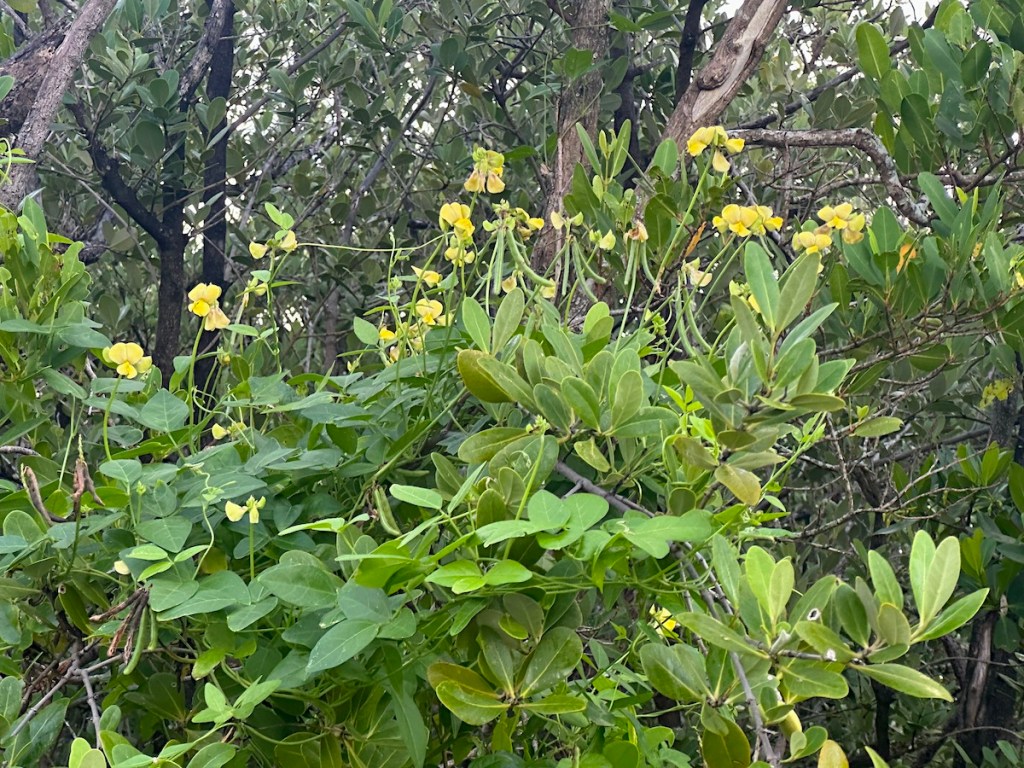
Its sunny yellow flowers are “typical” of legumes: the lower petal is fused into a” keel” and the petals above it are fused into “ears” …
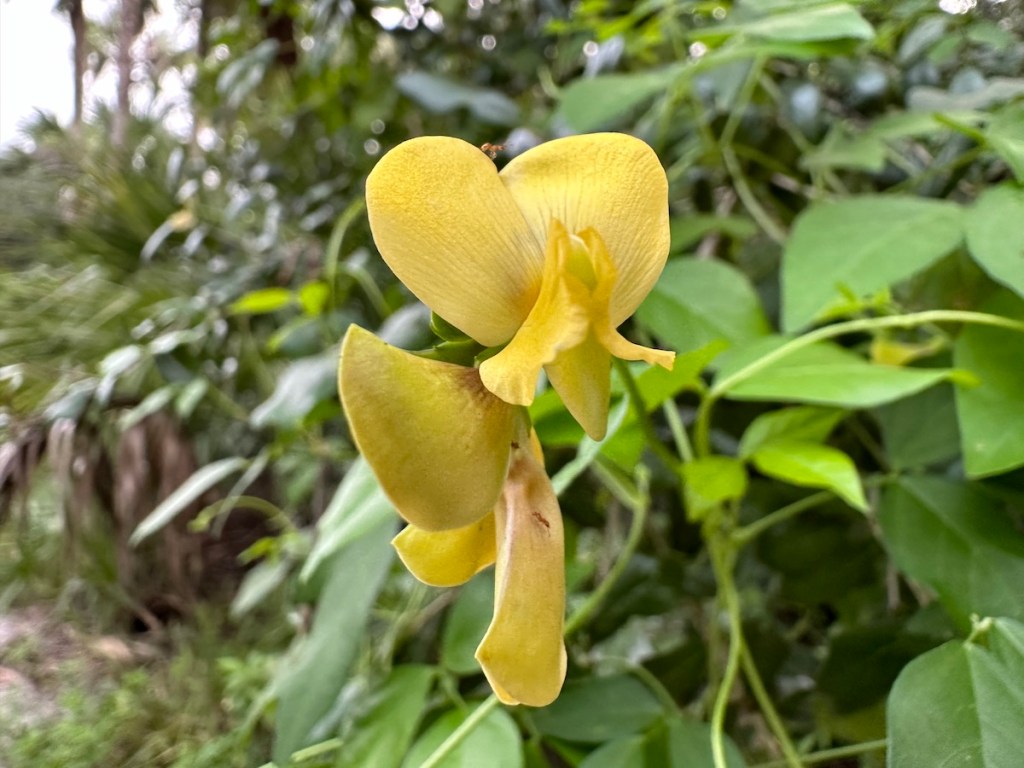
Look closely at the keel of the bottom flower, and you will spot a tiny ant. Many plants in the pea family have extrafloral nectaries, nectar-secreting glands that are not part of the flower. A recent study of hairy pod cowpea shows that ants are not effective pollinators, but they visit the extrafloral nectaries and help to repel nectar thieves. Bees are thought to be the primary pollinators. Butterflies also visit the flowers.
It is a larval host for cassius blue (Leptotes cassius), dorantes longtail (Urbanus dorantes), gray hairstreak (Strymon melinus) butterflies and long-tailed skipper (Urbanus proteus).

When you see ripe pods (legumes), it is easy to understand the reason for the common name hairypod cowpea. The genus name Vigna honors Professor Dominico Vigna, an 18th century botanist, which also is the genus of black-eyed peas (Vigna unguiculata), and the species name luteola means yellowish and references the flowers.
These pods split open (dehisce) length-wise to forcibly expel the tiny hard dark brown seeds. The seeds germinate readily in about 2 -3 weeks.
 Enjoy the Oslo Riverfront Conservation Area