

The pea family, Fabaceae, is quite diverse. When we visited Pelican Island National Wildlife Refuge (PINWR) on 10-8-2023, we saw grey nicker (Guilandina bonduc), a yellow-flowered, robust, and thorny vine. Never would you confuse it with hairypod cowpea (Vigna luteola), a much more diminutive and soft yellow-flowered vine that we also saw at PINWR.
Grey nicker can grow to be up to 25′ long and can be quite stout. Above it is pictured at Bird’s impoundment. Coastal strands and the edges of mangrove forests are its usual habitats. This plant exploits disturbance, and it has done so at the south end of the parking lot near Bird’s impoundment …

Gray nicker blooms throughout the year in south Florida, and this tropical, coastal plant ranges as far north as Volusia County. Racemes of yellowish-green flowers are held on tall spikes …
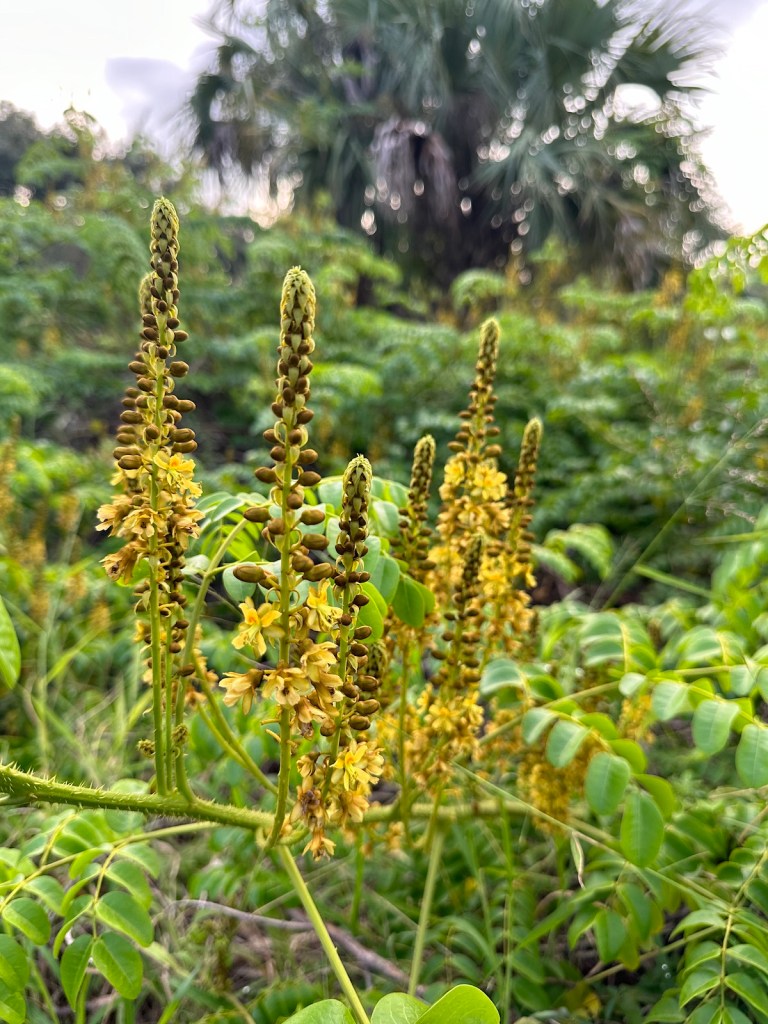
The flowers are fragrant and have 5 unfused petals …

Ants, butterflies, and bees visit the flowers for the nectar which has a high sugar content. They also visit the extrafloral nectaries located along the rachis, the main axis of the compound leaves. In addition, the flowers have a substantial quantity of dry, powdery pollen. Bees (melittophily) and wind (anemophily) are both thought to be the way that gray nicker gets pollinated.

The pods (legumes) – like the stems – are quite prickly. Inside each pod are 1 or 2 hard, smooth pale gray seeds. about the size of a nickel.

Sea pearl, nickernut, fever nut, and hold-back are other common names for this pantropical plant that is found in coastal areas in Africa, Asia, Australia, tropical America, and the Caribbean. The buoyant seeds float to disperse widely. Nicker is an old word for marble,, and the hard seeds are used as game pieces, for jewelry, and medicinally.
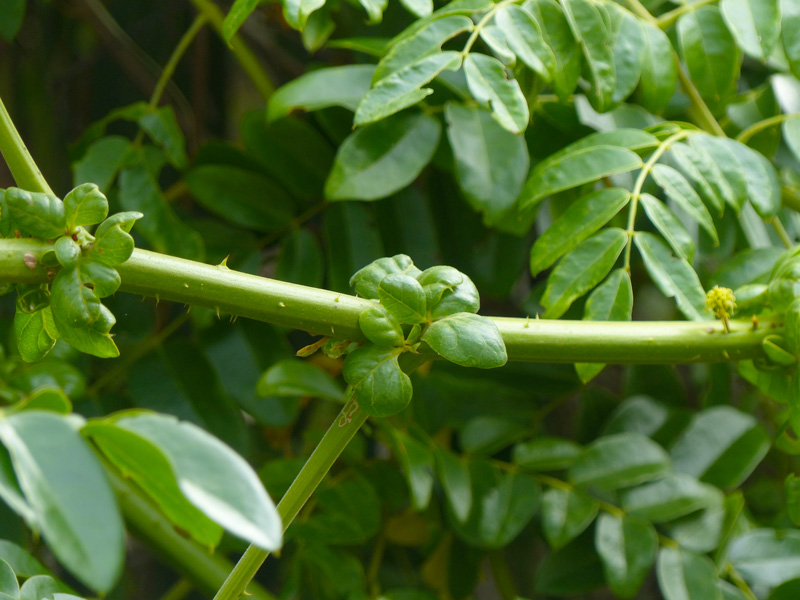
Hold-back refers to the protective armor of this plant. Its thick stems are armed with prickles (outgrowths from the epidermis of the plant) …

Caesalpinia bonduc once was the botanical name for this plant. The current genus Guilandina honors Melhior Wieland, a 16th century Prussian naturalist who reportedly changed his name to Guilandia because it sounded more Italian. The species name bonduc remains unchanged and is an Arabic word for hazelnut or filbert.
 Enjoy the Oslo Riverfront Conservation Area