

The 2024 Florida Medical Entomology Laboratory (FMEL) – Environmental Learning Center (ELC) Volunteer Nature Stewardship Class enjoyed a stroll on the ELC led by Marc Spiess, the ELC Campus Manager. On that walk he pointed out a beard lichen (Usnea sp.) growing on a live oak tree (Quercus virginiana) …
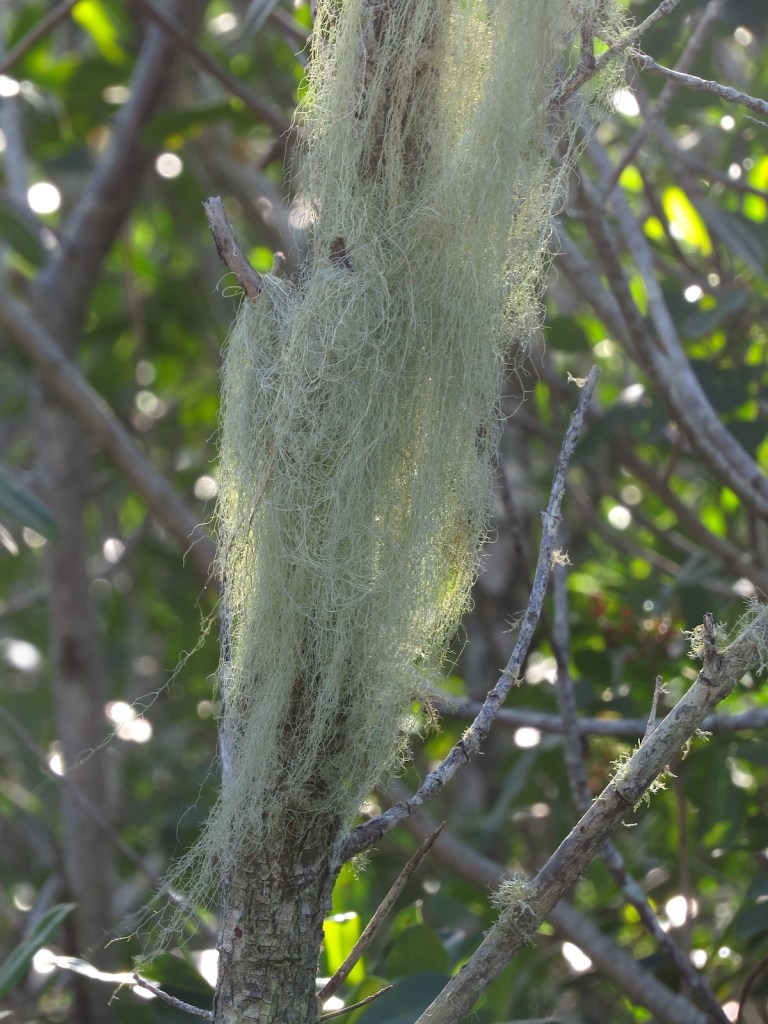
Marc noted that this lichen is increasingly uncommon in Florida and is a bio-indicator of air quality. A lichen is a combination of algae and fungus (& perhaps som other “stuff”) growing symbiotically: The algae does photosynthesis and provides food. Lichens do NOT have flowers.
At a glance, you might assume that the beard lichen is Spanish moss (Tillandsia usneoides), a common epiphyte that is emblematic of the South and is seen below growing very lushly at the North Oslo Riverfront Conservation Area parking lot in a year with lots of rain …

Karl Linnaeus coined the scientific name for Spanish moss. The genus name, Tillandsia, honors Elias Tillandz (1640-1692), a Swedish-born doctor and, botanist. The genus name, usneoides, refers “back” to the beard lichen Usnea sp., which it resembles at a glance.
Spanish moss is a flowering plant. You will need to look carefully to spot its tiny and often well-hidden flowers …

Its seeds are wind-borne and are attached to silken parachutes that aid their dispersal by the wind.
Also notice the tiny hairs (trichomes) that grace the Spanish moss …

Beneath the silvery hairs is a wiry black “core”. Once upon a time, Spanish moss was an item of commerce. It was harvested and dried so that the inner core could be used to stuff mattresses and upholstered items. It was far softer than horse hair, which was used for similar purpose.
Spanish moss is not stretchy, but beard lichens are quite elastic. Beard lichens have a much finer, delicate texture.
The moral of this story: Take time to look carefully as you enjoy Nature.
 Enjoy the Oslo Riverfront Conservation Area