

National Pollinator Week runs from June 17 through June 23, 2024. Pollination isn’t simple. Some plants (e.g., grasses) are pollinated by wind, but many plants are pollinated by insects, birds, bats, and …
Bees perform the lion’s share of pollinator. Nearly all of our food crops are pollinated by European (non-native) honeybees that are transported throughout the U.S. for their pollination services.
European honeybees are generalists, as are some of our native bees. Florida is home to more than 300 species of native bees, almost all of which are solitary. Solitary bees sting only if seriously molested, because they do not have a hive to protect.
Carpenter bees nest in stumps, logs, dead tree branches, or in wood that has not been painted or varnished. One of the most common carpenter bees in our area is the Southern carpenter bee (Xylocopa micans). It is one of the two species of large carpenter bees found in Florida; There are 7 species of large carpenter bees found in the U.S.
You will find these dark, glossy bees visiting a variety of native plants including common beggarticks (Bidens alba), a cornucopia for pollinators …
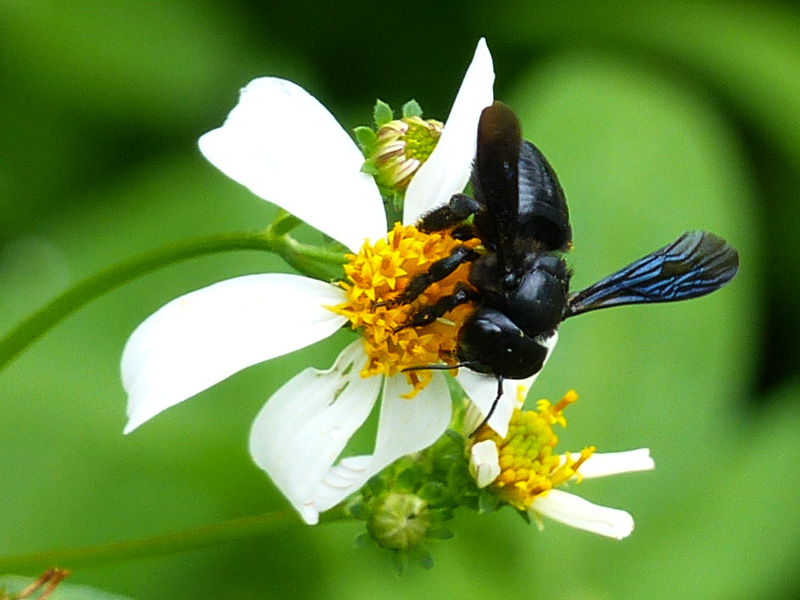

Carpenter bees excel at buzz pollination. They use vibrations to “shake” (sonicate) pollen from flowers for themselves pollinating the flowers at the same time. European honeybees are NOT capable of buzz pollination. Some crops like blueberries, tomatoes, and eggplants need buzz pollination.
Look carefully, and you often will find carpenter bees visiting partridge pea (Chamaecrista fasciulata), a common annual wildlfower that requires buzz pollination …


Some native plants have intimate relationships with specialist pollinators ad cannot be pollinated by generalist European honeybees. Look for – and enjoy – seeing our native solitary bees that bring us food and flowers.
 Enjoy the Oslo Riverfront Conservation Area