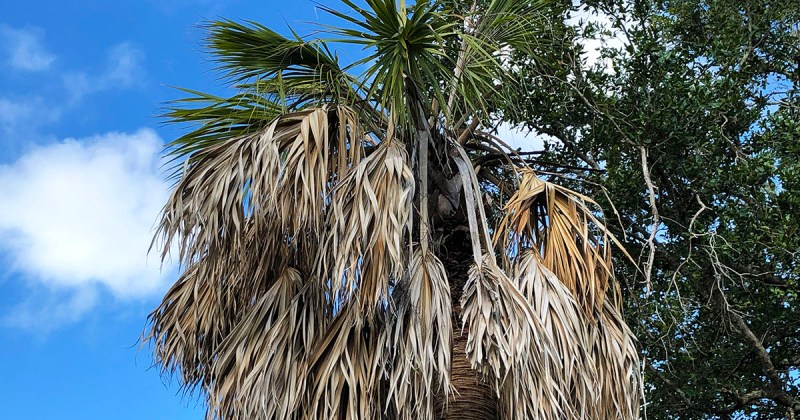

As I drive around Indian River County, I see more and more palms that have been killed by lethal bronzing – including cabbage palms (Sabal palmetto), our Florida state tree. Lethal bronzing is a phytoplasma, an intercellular parasite of plant phloem (plumbing), that is transported from palm to palm by a plant hopper the American palm cixiid (Hapalexius crudus).

Lethal bronzing arrived in Florida in Hillsborough County in 2006, when it was called Texas Phoenix palm decline. The 2 pictures above were taken in the yard of Jane Schnee (Class of 2010) in Sebastian in October of 2018, the first time that I saw evidence of lethal bronzing in Indian River County.
Symptoms appear about 4-5 months after infection, and then the palm quickly declines often in 2-3 months. Lower fronds show a bronze or reddish coloration and then die. Death progresses from the bottom to the top, and, ultimately, the growing spear collapses because the vascular system of the palm has been compromised. An overabundance of dead fronds at the bottom of a palm may be a tell-tale sign.
Rotting flower buds and premature fruit drop are other signs of lethal bronzing. The cabbage palm on the left, photographed at Treasure Hammock Ranch, has rotting flower buds and the characteristic death of the lower fronds. Will the healthy cabbage palm on the right succumb to lethal bronzing? Maybe or maybe not.

Some nearby cabbage palms clearly have died of lethal bronzing, but many others appear to be flourishing.
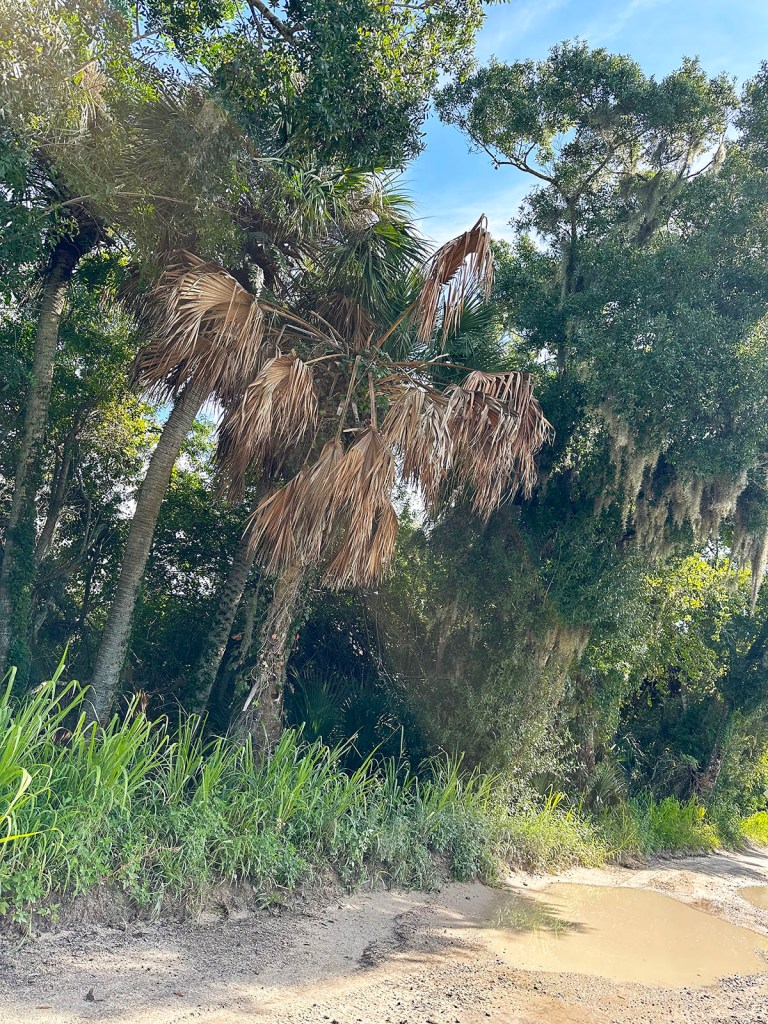
In our yard, three cabbage palms have died of lethal bronzing, but many other cabbage palms appear to doing fine. I did remove the growing stem from a small cabbage palm with lower leaves that were turning bronze. Why? The American palm cixiid is a tiny insect (2.5 to 3mm) that feeds only on the growing spear of palms. It is too small to feed on the harder tissues of the palm.
The only way to confirm that a palm is afflicted is by collecting a sample from inside the palm with a drill. Click here for instructions. Once a palm is infected, nothing can be done to save the palm, and the palm should be removed to prevent the spread of disease to nearby palms, or, in the case of young palms, the growing spear can be removed..
Lethal bronzing kills a variety of native and non-native palms. Click here for an ever-growing list of susceptible palms.
You may recall lethal yellowing, a similar pathogen, that wiped out most of the coconut palms (Cocos nucifera) in Florida. Lethal yellowing and lethal bronzing are transmitted by the same planthopper. The .dead and quite old coconut palm shown below is in a neighbor’s yard …

Below the dead coconut palm are dead or dying pygmy date palms (Phoenix roebelinii) …
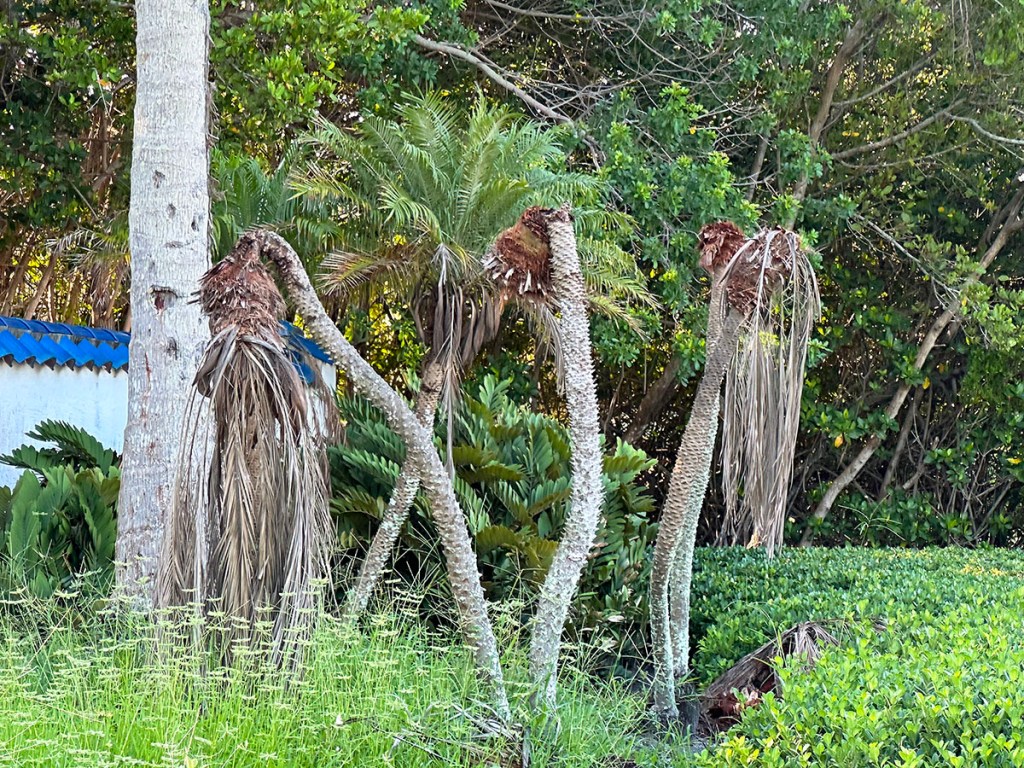
Note the characteristic collapse of the top of the palm due to the damage to vascular (plumbing)msystem of the palm. Below check out the characteristic bronzing on the fronds …

Fortunately, lethal bronzing cannot survive outside of a living host, so cannot be transmitted by pruning tools. Healthy palms can be treated with the antibiotic oxytetracycline hydrochloride every 3 to 4 months, an expensive & forever enterprise.
Take care! Watch your palms carefully.
 Enjoy the Oslo Riverfront Conservation Area