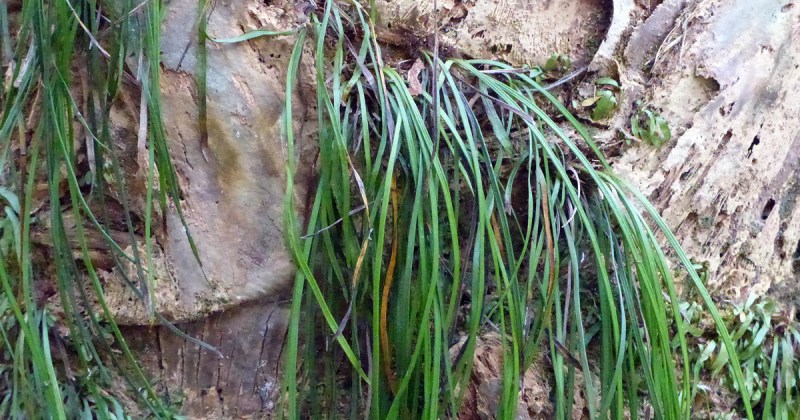

You will find shoestring fern (Vittaria lineata) growing on the trunks of cabbage palms (Sabal palmetto) in moist and shady places. Look for it in many natural areas including the South Prong Slough, the Denton Tract, the St. Sebastian River Preserve, the Cypress Bend Community Preserve, the Oslo Riverfront Conservation Area, and Captain Forster Preserve.

Also commonly called grass fern or beard fern, shoestring fern is a tropical epiphyte. In the U.S. it grows only in one county (Camden County in southeast Georgia) outside of the Florida peninsula. This fabulous fern grows throughout the West Indies, Mexico, Central America, and South America.
Its genus name Vittaria is derived from the Latin word vitta meaning band or ribbon. Its species name lineata means linear. Both the genus and the species name aptly describe its growth habit: Long narrow (filiform) leaves that can grow to be up to 2 feet long. At a quick glance you might think you saw a clump of long grass growing on a cabbage palm tree trunk.
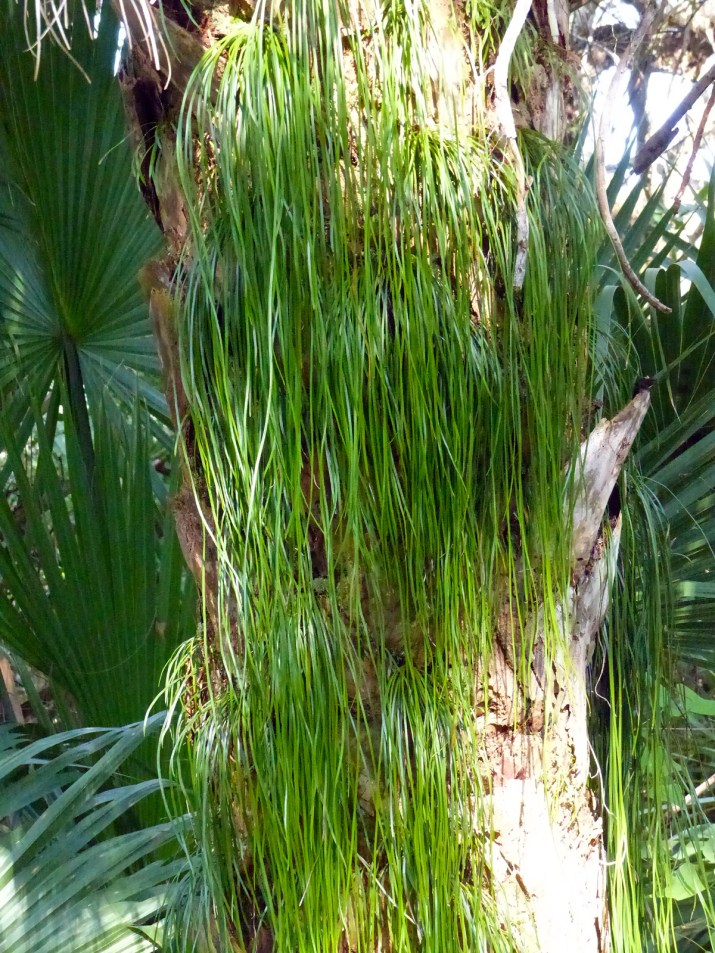
Shoestring fern grows from a delicate creeping rhizome that anchors it to a tree or in more tropical places to a rock or other surface. This plant is NOT a parasite. It does not take any nutrients from a plant on which it is anchored.
Truly minimalist in structure and function, shoestring fern “harvests” nutrients from the air and rainwater conducting photosynthesis – without roots that uptake water and nutrients from soil. When moisture is abundant, shoestring fern acts like a “normal” plant collecting carbon dioxide and releasing oxygen trhoughout the day. But, during dry times, this plant adopts a different water-saving strategy. It opens the breathing pores (stomata) located on the undersides of its leaves only at night and stores up energy as malic acid that it uses to conduct photosynthesis during the day. This complicated process is called Crassulacean acid metabolism photosynthesis.

Shoestring fern frequently is found growing alongside moss, a white-toned puffy moss (Octobelpharum albidum) or a a transulecent greenish moss (Syrrhopodon incompletus). Researchers have conjectured that these mosses provide a reservoir of moisture and dissolved nutrients to the fern.

Don’t be tempted to try to transplant this distinctive fern. Your efforts will fail, even if you bring the associated moss along. Enjoy this unique and almost endemic epiphyte when you visit natural areas.
 Enjoy the Oslo Riverfront Conservation Area