

Now is the time when the sweet scent of saw palmetto (Serenoa repens) perfumes the air. This usually low-growing palm (repens means reclining) grows throughout the entire state of Florida. It is endemic to southeastern U.S. from Louisiana to North Carolina.
The fragrance seems to “accumulate” of the course of a day and is very attractive to pollinators. Dr. Mark Deyrup documented more than 300 species of insects visiting saw palmetto flowers at Archbold Biological Research Station: “A list of 311 species of flower visitors was dominated by Hymenoptera (121 spp.), Diptera (117 spp.), and Coleoptera (52 spp.). Of 228 species whose diets are known, 158 are predators, 47 are phytophagous, and 44 are decomposers.” Hymenoptera are bees and wasps. Diptera are flies. And, Coleoptera are beetles.
Each saw palmetto inflorescence (flower stalk) can be up to 3′ long with thousands of tiny creamy white flowers that open over time. A saw palmetto may have 3 to 5 inflorescences. Flowering occurs in spring or early summer.
With the drought this winter the saw palmettos in our yard have been “troubled”. Many flower stalks have “dried up” but not the one nearest our front door. It was abuzz with pollinators including this distinctive solitary wasp.

Initially I thought it to be a four-toothed mason wasp (Monobia quadridens), but more careful examination showed that it was a white-striped black wasp (Pseudodynerus quadrisectus). It is more slender than the four-toothed mason wasp, smaller in size, and has two white bars (rather than one) on its abdomen. Solitary wasps sting only when provoked, unlike European honeybees (Apias mellifera) which are more likely to sting to protect their hive …

Predatory insects and other creatures like lizards also find saw palmetto attractive …
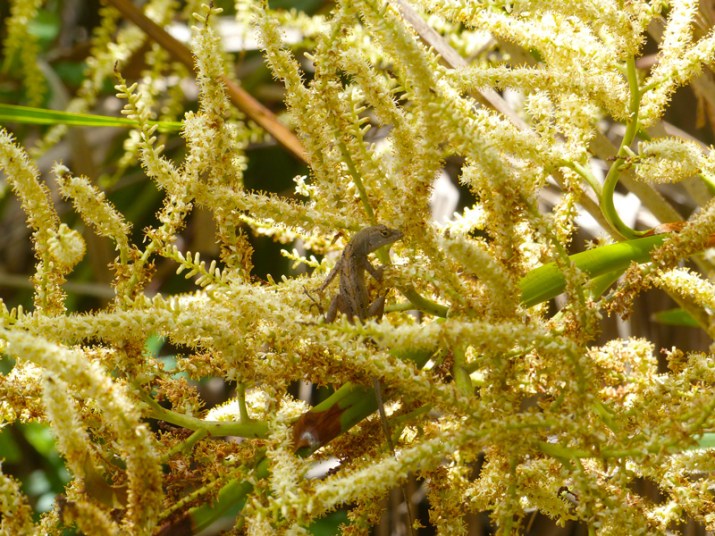
Bees are the primary pollinators of this plant, though many different insects (and other creatures) visit its fragrant flowers. Be on the “lookout” for its sweet fragrance …

 Enjoy the Oslo Riverfront Conservation Area