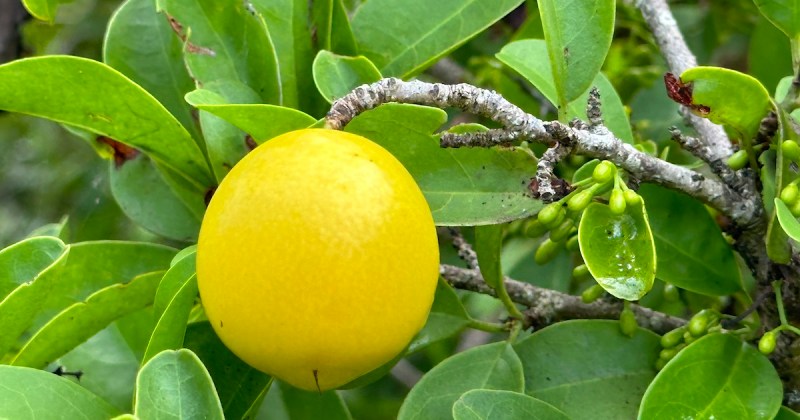

Another native plant with seeds that float for long distances is tallow wood (Ximena americana). You will find this plant growing in sandy places – both beach and scrub. Inside the delicious, fragrant fruit is a seabean, a seed that is capable of floating on ocean currents. Enjoy the pulp but avoid eating the seed, which has purgative properties. Hence, this plant also is called purge nut.
Each fruit (drupe) contains one roundish seed (pit or stone), and these seeds are variable in shape. Shown below are the seeds from which I cleaned the pulp to plant …

Fruiting sometimes is prolific, as seen below in a picture taken along Highway A1A in northern Indian River County. Note the number of fruits that have fallen to the ground, where gopher tortoise enjoy feasting upon them …

Also called hog plum, yellow plum, and sea lemon, tallow wood grows in subtropical and tropical places throughout the world including Africa, Asia, Australia, and the Americas. Florida is the only state in which this plant grows.
Once the flesh is gone, the endocarp becomes buoyant and is capable of floating for up to a year, according sea bean export and retired Sebastian Inlet State Park Ranger Ed Perry. Here in Florida it is hard to know if the tallownut came from a Florida plant or elsewhere.
Tallow wood has an interesting ability to “tap into” the roots of adjacent plants via specialized structures called haustoria. It is a facultative hemi-parasite: It can perform its own photosynthesis, but, given the opportunity, will draw nutrients from nearby plants. Without an “assist” from other plants, tallow wood tends to have yellowish green leaves.

With nutritional “assistance” gained from the roots of nearby plants, tallow wood tends to be greener …

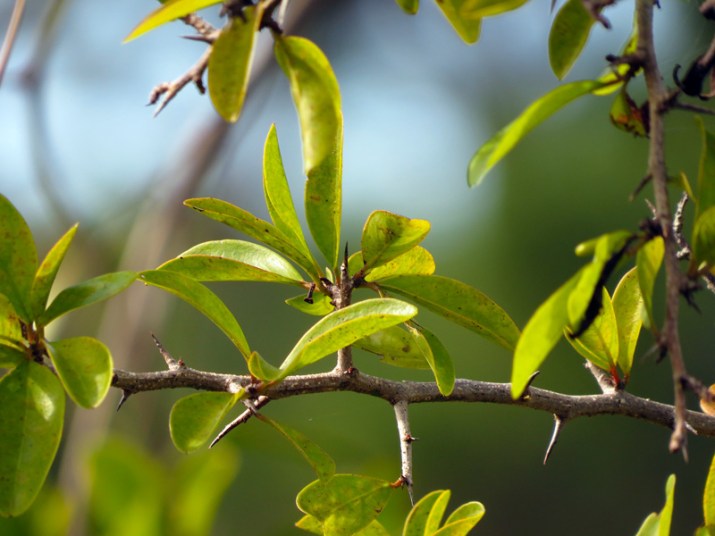
Approach this plant with care for its zig-zag stems are armed with significant straight spines (1/4″ to 1/2″) …
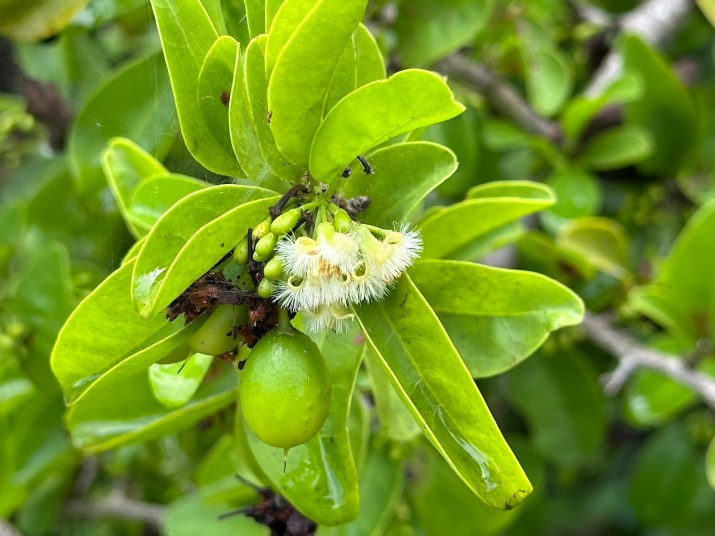
Its flowers are fuzzy, and flowering and fruiting sometimes occurs simultaneously …
Fruits ripen from green to golden yellowish (or sometimes orange-ish), and, once free of its flesh, the seed is capable of ocean-travel. Pictured below are two tallownut seabeans that I picked up on the beach.

 Enjoy the Oslo Riverfront Conservation Area