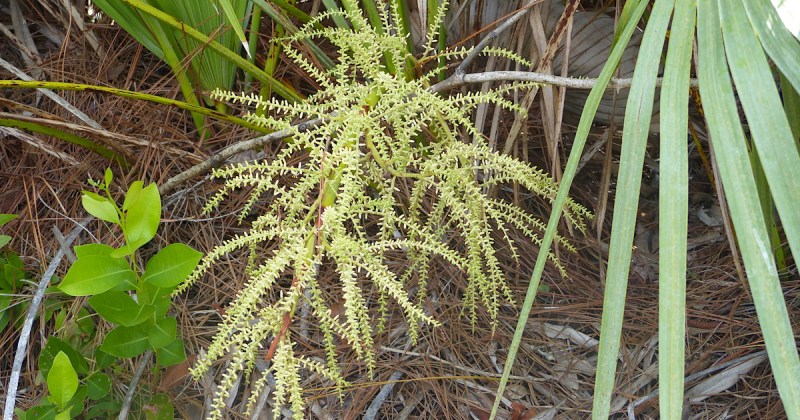

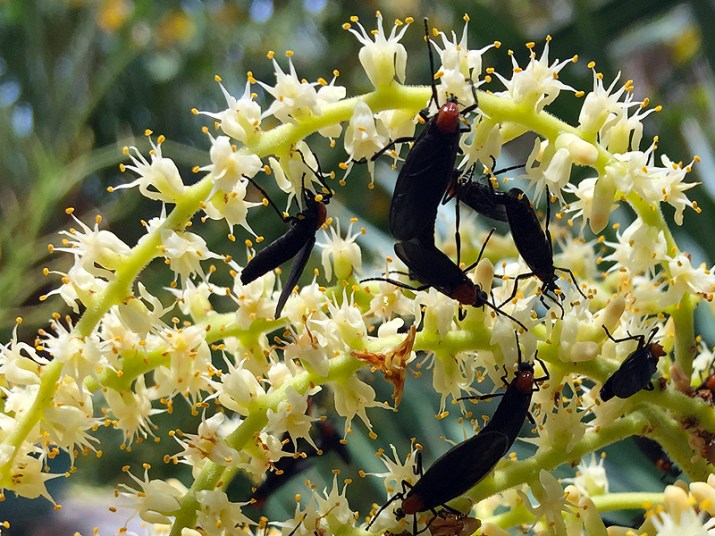
Lots of insects visit the sweetly fragrant flowers of saw palmetto (Serenoa repens) including lovebugs (Plecia nearctica). Lovebugs emerge in large numbers twice a year: Late spring (April/May) and fall (August/September).
Male lovebugs emerge before the females. Once coupled, the male and female love bugs live for a few days nectaring on plants. A female lays an average of 350 eggs usually under decaying vegetation. The larvae feed on the decaying vegetation then pupate. The pupal stage lasts 7 to 10 days.
Lovebugs serve us as decomposers and provide food source for insectivorous birds, lizards, and other creatures. Lovebugs are harmless to humans, though their large numbers can be daunting.
Bees, primarily, pollinate saw palmetto. Lovebugs may play an incidental role. In a 2003 paper published in the journal, Palms, titled Pollination Services in Saw Palmetto (Serenoa repens) in southwestern Florida, noted that: “Two Diptera species carried pollen on their bodies (Table 1). The first, Plecia nearctica (Bibionidae; lovebug) was a very common visitor. Single or coupled individuals actively foraged for nectar, crawled over numerous flowers, or simply lay on inflorescences, sometimes remaining for hours. Lovebugs usually carried pollen (typically <100 grains) on various parts of their bodies.”
But, where have all the lovebugs gone?
No one really knows. The photo above was taken in 2017. Each year there seem to be less and less lovebugs. I have only encountered about a dozen this year.
Entomologists conjecture that climate change, urbanization/habitat loss, pollution, new parasites and diseases, and predators could be factors.
Lovebugs seem to “love” white flowers. In the fall, they often nectar on white crownbeard (Verbesina virginica), also known as frrostweed …

… Juba’s bush (Iresine diffusa) …

… and Simpson’s stopper (Myrcianthes fragrans), which sometimes flowers both in the spring and fall …

I miss seeing lovebugs nectaring. I don’t miss them smashed on my car.
 Enjoy the Oslo Riverfront Conservation Area