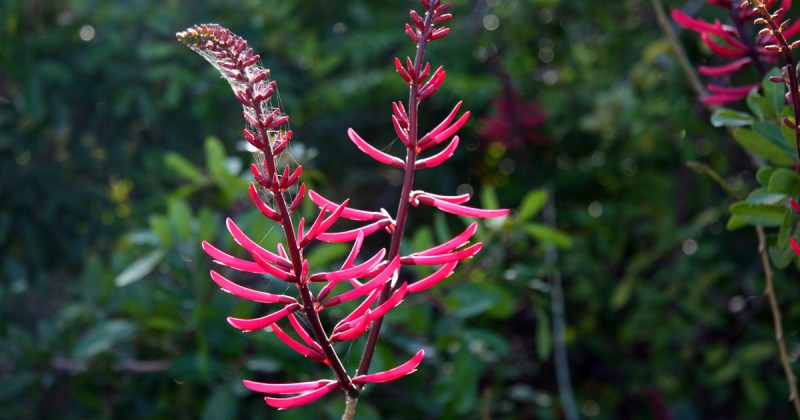

Another seed capable of ocean transport comes from yet another native member of the pea family (Fabaceae), coralbean (Erythrina herbacea). Also called Cherokee bean, this tropical tree grows throughout Indian River County including at the Oslo Riverfront Conservation Area, Captain Forster Hammock Preserve, Pelican Island National Wildlife Refuge, and Sebastian Inlet State Park.
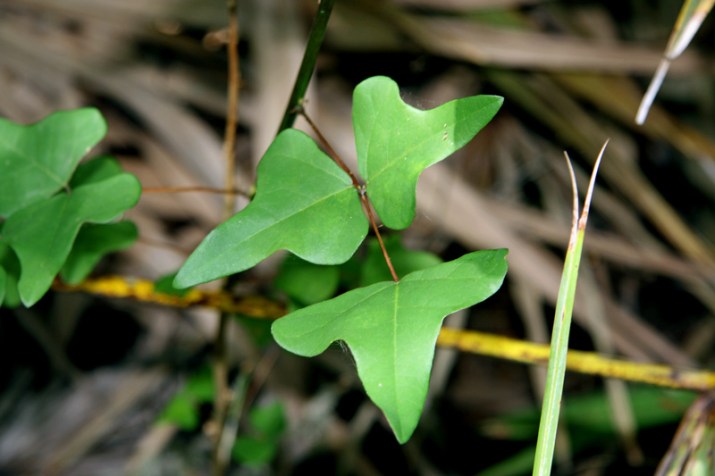
Like many plants in the pea family, it holds its leaflets in 3’s …
Flowering and fruiting occur in the winter and early spring. Its spikes (racemes) of tubular scarlet flowers are quite striking and attract hummingbirds, long-tongued butterflies, and other pollinators. When grown from seed, they have a bulbous base and a strong root system, as shown by the coralbean pictured below on a mosquito control dike at Pelican Island National Wildlife Refuge that flowered after being mown down to the ground …

Long pods that split length-wise (dehise) follow the fruit and contain hard-coated coral seeds …

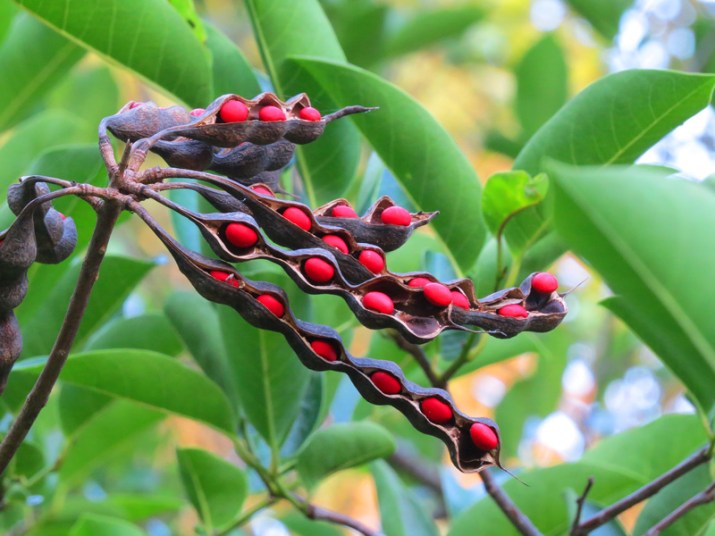
The seeds are poisonous, but, nonetheless, are used in jewelry-making and other crafts. According to The World Guide to Tropical Drift Seeds and Fruit by C.R. Gunn and J.V. Dennis, the seeds are capable of floating for up to 2 years. At Sebastian Inlet State Park, you will find this tropical tree growing amongst the saw palmettos (Serenoa repens) on the east side of Highway A1A.

 Enjoy the Oslo Riverfront Conservation Area